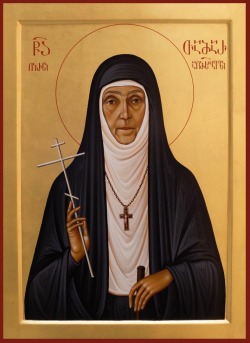
Mother Superior
Schema Nun Famar, in the world Princess Tamara Alexandrovna Mardzhanova, was born in the late sixties of the last century into a wealthy Georgian family. She received a good upbringing and education. In the family of the Mardzhanov princes, the atmosphere was more secular than ecclesiastical. Tamara Alexandrovna's father died when she was small, and her mother when she was twenty.
Tamara had great musical abilities and was preparing to enter the St. Petersburg Conservatory when her fate changed. After her mother's death, in the summer, she was visiting her aunt in the city of Signi, near the women's monastery in honor of St. Nina in Bodbe, with her sister and younger brothers.
One day, the youth went to see the new Bodbe Monastery. There, at the service, Princess Tamara was struck by the spiritual atmosphere and decided to dedicate her life to God, to become a nun. She approached Abbess Juvenalia and expressed her desire.
Tamara's cousin, having overheard the conversation, told her relatives, and they began to mock her. Despite their pleas, Tamara did not change her decision. Her relatives tried to distract her by taking her to Tiflis, but in the end, she left home and went to the monastery, where Abbess Juvenalia accepted her.
Tamara was tonsured into the riasophor, and then into the mantle with the name Juvenalia. In 1902, Abbess Juvenalia the Elder was transferred to Moscow, and Juvenalia the Younger became the Abbess of the Bodbe Monastery. She loved her monastery very much, but soon faced difficulties.
In 1905, revolutionarily inclined mountaineers oppressed Georgian peasants, and Abbess Juvenalia took them under her protection. The revolutionaries threatened her, and eventually, she was transferred to Moscow, where she became the superior of the Protection community. There she became close to Grand Duchess Elizabeth Feodorovna.
Desiring solitude, she went to the Seraphimo-Ponetaevsky Monastery, where she received a command from the Mother of God to create a new skete. With the blessing of the elders, she founded the Seraphimo-Znamensky skete, which was consecrated on September 29, 1912.
The skete existed for twelve years and was closed by the Bolsheviks in 1924. Tamara and her sisters settled in Perkhushkovo, where she continued her spiritual life. In 1931, she was arrested and sent to Siberia, where she spent three years in exile.
After her exile, she returned to Moscow, but her health deteriorated. She passed away on June 10/23, 1936. She was buried on the Vvedensky Hills in Moscow, where her grave remains to this day.
