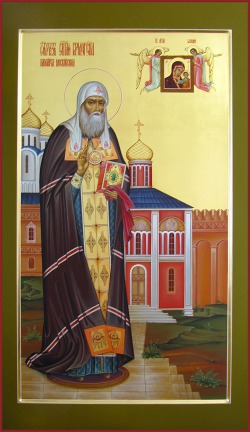
Patriarch
Saint Hermogenes the Hieromartyr, Patriarch of Moscow and All Russia, was born around 1530 into a Don Cossack family. In his youth, he witnessed the appearance of the Kazan Icon of the Mother of God. After embracing the monastic life, he received the name Hermogenes, was appointed archimandrite of the Kazan Monastery, and later became a metropolitan. He carried out remarkable missionary work, bringing many pagans and Muslims into the Orthodox faith.
In 1592, he transferred the relics of Saint Germanus of Kazan, and in 1594 he composed a liturgical service in honor of Theotokos of Kazan. On 3 July 1606, he was appointed Patriarch of Moscow and All Russia. His patriarchate coincided with the difficult period known as the Time of Troubles, during which he resisted both the enemies of his homeland and the spread of Uniatism.
Patriarch Hermogenes appealed to the people, urging them to rise up and defend their country. During the great famine, he opened the storehouses of the monasteries to those who were starving. He also strengthened the faith of the monks who defended the Holy Trinity–Saint Sergius Lavra.
In 1610, following the overthrow of tthe Tsar Vasily Shuisky, Moscow was occupied by Polish forces. Hermogenes refused to recognize the Polish Prince Władysław as ruler. Instead, he called upon the people to defend their homeland and gave his blessing to the armed struggle for liberation.
Saint Hermogenes the Hieromartyr became a martyr on 17 February 1612, suffering from hunger and thirst while imprisoned. His death inspired the faithful, who on 27 October 1612 achieved a decisive victory over the Polish-Lithuanian forces. His body was buried in the Chudov Monastery, while in 1654 his incorrupt relics were translated to the Cathedral of the Dormition of the Most Holy Theotokos in the Moscow Kremlin.
