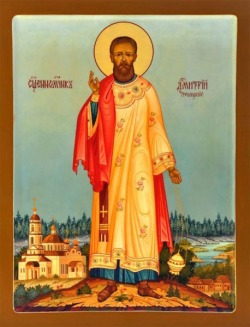
Deacon
Saint Demetrius Troitsky was born in 1884 in the village of Maksaevo, in Kolomensky Uyezd, Moscow Governorate. He was born into the family of Deacon Vasily Troitsky. After graduating from the Kolomna Theological School in 1901, he began serving as a cantor at the Church of the Transfiguration in the village of Pokhinki, in the Ryazan Governorate. In 1924, he was ordained a deacon. In 1930, he was sentenced to eighteen months in exile for failing to fulfil the grain requisition. After serving his sentence, he continued to serve as a deacon. Upon his return in 1932, he resumed his position at the church.
In January 1933, the authorities arrested the priest, along with several other faithful parishioners. During the interrogation, he admitted to associating with members of the clergy, although he could not recall the details of their conversations. Witnesses confirmed that he had expressed complaints and dissatisfaction with the policies of the Soviet authorities. On 19 May 1933, he was sentenced to three years of exile in Kazakhstan.
In 1936, he returned to the village of Pokhinki. His family lived there in the home of the church caretaker. However, his poor health prevented him from conducting services himself. He therefore began attending the church simply as a parishioner.
In 1937, a new wave of persecution against the Russian Orthodox Church began. On 5 September, he was arrested again and charged with counter-revolutionary propaganda. During interrogations, he firmly maintained his innocence. On 19 September, the NKVD troika sentenced him to death. The Holy New Martyr Demetrius was executed on 21 September 1937 and buried in an unmarked mass grave at the Butovo execution range near Moscow.
