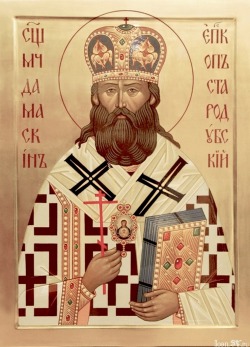
Bishop
Saint Damaskin, Bishop of Starodub, Vicar of the Chernigov Diocese, was born in 1877 in the city of Mayaki, Odessa County, Kherson Province, in the family of a postal official. He graduated from the Theological Seminary and the Vladivostok Agricultural Institute, then took monastic vows with the name Damaskin and served as a missionary at the Beijing Spiritual Mission. In 1918, he was arrested and sentenced to death, but escaped execution. His brother, Priest Nikolai, was shot for opposing the Bolsheviks.
For some time, Father Damaskin lived in the Mikhailovsky Monastery in Kyiv, served as an eparchial missionary, and was a student at the Kyiv Theological Academy. In 1919, he was elevated to the rank of hieromonk. In 1920, he was appointed the abbot of the Balaklava Georgievsky Monastery in Crimea. Soon he was arrested again but was released and expelled from Crimea.
Father Damaskin fought against Renovationism. On September 14, 1923, he was consecrated as Bishop of Starodub by Patriarch Tikhon. He managed the Chernigov Diocese and the Glukhov Vicariate. After several arrests, he was severely weakened but continued to serve. In 1924, he was exiled to Kharkov, and from September 1925, he lived in the Danilov Monastery in Moscow without the right to leave. In November 1925, he was arrested again and sentenced to three years of exile in the Turukhansk region.
In 1927, he was shocked by the 'Declaration' of Metropolitan Sergius and wrote about 150 letters regarding it. In 1928, he met with the future saint, Metropolitan Kirill. In 1929, he became close to the supporters of Saint Metropolitan Joseph and refused the proposals of Metropolitan Seraphim.
In November 1929, he was arrested and sentenced to 10 years in camps. In 1930, he was sent to Solovki, released in 1933, and headed several Josephite communities. In September 1934, he was arrested again and sentenced to 3 years of exile in the Northern region.
In 1935, he wrote a letter to Josephite priests about the necessity of transitioning to an illegal status for the Church. In early 1936, he was arrested again and sentenced to imprisonment in camps. In the Karaganda camp, he worked as an accountant and saved his friend from execution. On September 2 (15), 1937, he was shot.
He was canonized among the ranks of the New Martyrs and Confessors of Russia at the Jubilee Archpastoral Council of the Russian Orthodox Church in August 2000 for public veneration.
