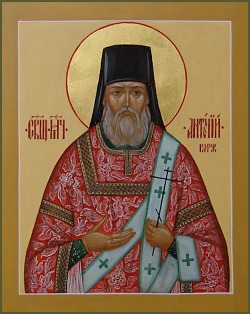
Hierodeacon
Saint Anthony the Confessor was born in 1888 in the village of Rubanovka, Melitopol district, Tavrida province, in the family of a peasant, Agafon Korzh. He graduated from the church-parish school and, like many young men from pious peasant families, went on a pilgrimage to Mount Athos, where he took monastic vows under the name Anthony. After returning to Russia, he was ordained as a hierodeacon and served in the Kiziltash Monastery of the Tavrida diocese. After the closure of the monastery, he began serving in the Resurrection Church in the village of Livadia, and then in the Plescheev Church at the cemetery of Yalta, where he served until the persecutions of 1937.
At that time, the authorities closed the Yalta Alexander Nevsky Cathedral, and the faithful, along with the clergy, began to demand its reopening. Hierodeacon Anthony, together with the parishioners, went to the city executive committee to obtain permission to register a new twenty, but they were denied. By the blessing of the rector of the Plescheev Church, he gathered active parishioners to develop a solution on how to achieve the reopening of the cathedral. In early 1937, the faithful decided to appeal to the city executive committee again, but the authorities refused, not arresting them, as extraordinary laws had not yet been enacted. However, in the second half of 1937, all active participants were arrested, and Hierodeacon Anthony was arrested on December 9, 1937.
During the interrogations, the hierodeacon categorically refused to incriminate himself or admit guilt. The investigator collected testimonies from false witnesses and those who had slandered Father Anthony, but he did not confirm them. On December 24, the investigation was completed, and on February 9, 1938, the NKVD troika sentenced the hierodeacon to execution by firing squad. Saint Anthony the Confessor (Korzh) was executed on March 14, 1938, and buried in a common grave.
