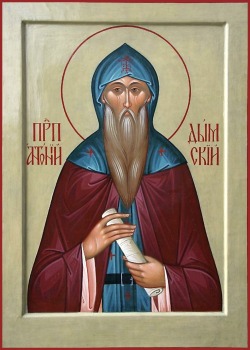
Saint Anthony of Dymsk was born in 1157 in Novgorod. From childhood, he was taught the rules of Christian piety and avoided childish games. Inspired by the words of the Gospel, he decided to leave his parental home and become a monk, taking monastic vows at the Hutyn Spaso-Transfiguration Monastery.
Living in obedience to his elder, Saint Anthony diligently fulfilled all obediences and did not miss church services. After a trip to Constantinople, he returned to the monastery, where he became the abbot after the death of Igumen Varlaam.
While managing the monastery, he adhered to the rule and adorned the church in honor of the Annunciation of the Most Holy Theotokos. Saint Anthony left the monastery and withdrew to the Dymsk forests, where he founded a hermitage and built a cell. He patiently endured heat and cold, battling temptations.
Monks began to come to him, and thus the Dymsk Monastery arose, where he became the abbot. The monks built a church in the name of Saint Anthony the Great and other buildings. Saint Anthony wisely governed the brotherhood until his blessed repose on June 24, 1224, after which his body was buried in the church.
The holy relics of Saint Anthony were found incorrupt in 1330. In 1409, during the Tatar invasion, the relics were hidden. Saint Anthony remained the guardian of the monastery, and the monastery revived after being ravaged by the Swedes in 1611.
The memory of Saint Anthony is celebrated twice: on January 17 and June 24. In 1744, a wooden tomb was arranged over the place of his concealment. In icons, he is depicted with a charter containing the words: Behold, I have departed, fleeing, and I have dwelt in the wilderness.
