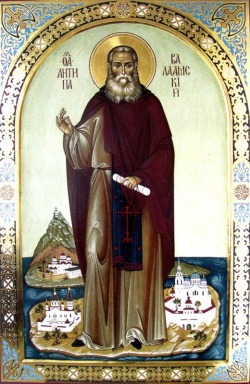
In the world, he was known as Lukaian Alexander Georgievich, born in 1816 in the village of Kalapodeshti in the Teceuc County of Moldova to a deacon's family. From childhood, he was pious and meek, showing diligence in his studies and reading spiritual literature. Having lost his father at an early age, his mother took the veil as a nun. At the age of 20, he decided to become a monk.
After an unsuccessful attempt to enter the Neamț Monastery, he was accepted into a small monastery in Wallachia, becoming a disciple of the schema-monk Gideon. He was tonsured with the name Alipius by Archimandrite Dimitri at the Braz Monastery and went to Mount Athos, where he entered the Greek Monastery of Esphigmenou. For four years, he worked in the kitchen, then moved to the hermits Elder Niphon and Nectarios.
He accepted the schema with the name Antipas and began to live the life of an anchorite, obtaining a miraculous icon of the Mother of God. At the request of Elder Niphon, he entered the Moldavian skete that was being built, was ordained as a hieromonk, and managed the skete, fulfilling the duties of a spiritual father. He was engaged in fundraising for the skete in Moscow and St. Petersburg, where he acquired many disciples.
In 1865, he arrived on Valaam Island at the Skete of All Saints, took on the ascetic life of an elder, was a fervent prayer and strict faster, and possessed the gift of foresight. He reposed on January 10, 1882, on Valaam, and was buried outside the walls of the All Saints Skete. His grave was opened in the 1960s, and the relics were found on May 14, 1991, emitting a fragrance. The relics were transferred to the Church of the Apostles Peter and Paul, and later to the Church of Sergius and Herman of Valaam.
The Romanian Orthodox Church canonized him in 1992 as the only monk from Romania to be numbered among the saints on Athos. In 2000, his name was included in the Menologion of the Russian Orthodox Church.
