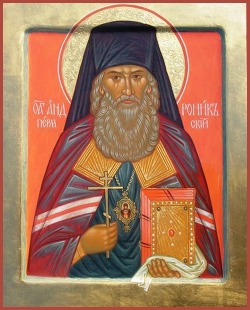
Archbishop
He was born on August 1, 1870, into the family of a deacon of the Yaroslavl diocese. From an early age, he engaged in peasant labor and actively participated in church life. He received his education at the Uglich Theological School and the Yaroslavl Theological Seminary, then entered the Moscow Theological Academy, where he took monastic vows in 1893, receiving the name Andronicus.
After graduating from the Academy in 1895, he became a hieromonk and was appointed assistant inspector at the Kutaisi Theological Seminary. In 1897, he was appointed a missionary to Japan, where he worked under the guidance of Saint Nicholas. He returned to Russia due to illness and became the rector of the Ufa Seminary.
On November 5, 1906, he was consecrated as the Bishop of Kyoto and returned to Japan, where he established an Orthodox community in Osaka. In 1908, he was appointed Bishop of Tikhvin, vicar of the Novgorod diocese. During his service, he observed a departure of society from the Church and actively opposed godlessness.
In 1913, he was appointed to Omsk, where he organized church life in resettlement villages. In 1915, he was appointed Bishop of Perm, where he distinguished himself as a ascetic and missionary archpastor, caring for the poor and organizing various church events.
During World War I, he opened hospitals for the wounded and actively visited them. In 1917, after the February Revolution, he expressed his sorrow over the abdication of the Emperor and warned the people about the internal enemy. Soon after, he began to be persecuted and was arrested.
On June 6, 1918, he was shot by Chekists after brutal torture. His martyr's death became a symbol of fidelity to Christ and the Church. In 2000, he was canonized among the New Martyrs and Confessors of Russia for public veneration.
