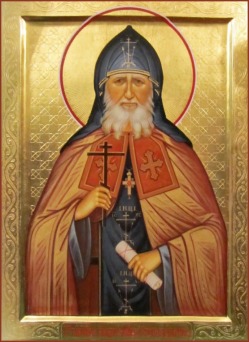
He was born on February 12, 1889, in the village of Luppa, Poltava province, to a peasant family of Andrei and his wife Akilina. He received his primary education at a church parish school. In 1905, wishing to dedicate his life to God, he arrived at the Glinskaya Desert and was accepted into the brotherhood. He served in various obediences, learning from the elder Fr. Iulian.
In 1915, he was drafted into the army, captured by the Austrians, and spent three and a half years in captivity, diligently praying and accepting sufferings as from the hand of God. Upon returning to the monastery in 1918, he was appointed to the position of economist and in 1920 was tonsured into the rassophore, and in 1921 he took monastic vows with the name Andronic.
After the closure of the Glinskaya Desert in 1922, he was ordained as hierodeacon. In 1923, he was exiled to Kolyma for 5 years, where he served as a nurse in the prison hospital, caring for the sick with sincere compassion. In 1936, he was awarded a gold pectoral cross.
He was sentenced for the second time in 1939, spending 11 months in prison, where he was subjected to torture but remained faithful to his faith. In the camp, he worked as a day worker, earning respect among both the prisoners and the guards.
On September 28, 1948, he returned to the Glinskaya Desert, where he was appointed as the archimandrite and sacristan of the monastery. His spiritual life attracted many, and he became a spiritual mentor for the brethren. On May 5, 1955, he was elevated to the rank of schemamonk.
After the closure of the monastery in 1961, he moved to Tbilisi, continuing his ministry. He served in the church of St. Alexander Nevsky, where many came seeking salvation. In 1963, he was elevated to the rank of archimandrite.
He died on March 21, 1973, leaving behind a memory of his virtuous life and spiritual service. He was buried in Tbilisi, where his grave became a place of veneration.
