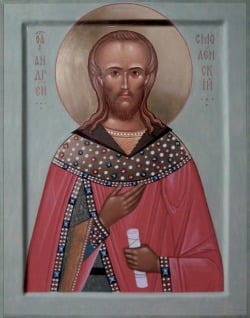
Saint Andrew, the Smolensk prince, was forced to leave his principality due to the envy and treachery of his relatives. He hid in the city of Pereyaslavl-Zalessky around 1360, settling by the Church of Saint Nicholas the Wonderworker, where he served in humility for thirty years, concealing his noble origin. He died around 1390, and on his body were found signs of princely dignity and iron chains, testifying to his humility. He was buried by the Nicholas Church, and his body was wrapped in birch bark.
The inhabitants of Pereyaslavl long remembered the saint, and soon after his death began to celebrate his memory on October 27. However, around the mid-16th century, the celebration ceased, and the saint was forgotten. The Venerable Daniel, a native of Pereyaslavl, decided to restore the memory of the holy prince.
In the last year of his life, he appealed to Tsar Ivan Vasilyevich IV and Metropolitan Ioasaf with a request to restore the churches in Pereyaslavl and to uncover the grave of Saint Andrew. Having received permission, Daniel organized the uncovering of the grave, where it was discovered that the body of the saint remained intact despite decay. A multitude of people gathered for this event, and many were healed from ailments by touching the birch bark of his relics.
Despite the testimonies of miracles, Metropolitan Jonah and Archimandrite Guriy refused to glorify the saint. The Venerable Daniel predicted sorrows for their disbelief, and his predictions came true. Daniel's efforts for the glorification of the saint were not in vain: the memory of the holy prince was revived, and in 1749, the local celebration was approved by the Holy Synod.
Miracles continued to occur at his grave, and today the holy relics of the blessed prince Andrew rest in the Church of Saint Nicholas.
