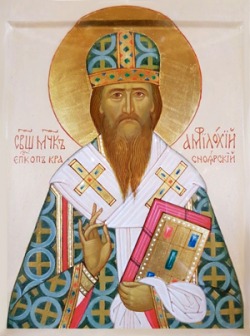
Bishop
Saint Amfilohije (in the world Alexander Yakovlevich Skvortsov) was born on February 17, 1885, in the village of Norvashi, Tsivilsky district of Kazan province, in the family of psalmist Yakov Vasilyevich Skvortsov. Alexander was the youngest in the family, which had eleven children. His elder sister married in Poland, and he never saw her. One of his brothers served as a priest in the Kazan diocese. He received his initial education at the Cheboksary Theological School. From a young age, he felt a calling to monastic life and wished to enter a monastery. After being tonsured on March 22, 1907, he was named Amfilohije. In 1908, he was ordained to the rank of hierodeacon, and in 1910 – to the rank of hieromonk. In 1909, he was sent to the Astrakhan Kalmyk steppe to study the Kalmyk language. His scholarly activity manifested in the work 'Religious-Moral Translations into the Kalmyk Language as a Means of Missionary Influence.'
In 1912, he was sent to Mongolia to study the Tibetan language. Upon returning, he actively participated in the work of the Historical-Ethnographic Museum in Kazan. In 1914, in the Kazan Spiritual Academy's church, the baptism of three Chinese individuals took place, who turned to God thanks to his efforts. The October Revolution made a profound impression on him, and he realized that the new ideology of socialism threatened Orthodoxy. In 1918, he moved to the Uspensky Men's Monastery, and then in 1921, he was assigned to serve in the church in the village of Bely Yar. In 1922, after the transition of Bishop Zosima to Renovationism, he was dismissed from managing the parish.
In 1922, he moved to a women's monastery in Matura, where he lived for half a year. In 1931, he was arrested and imprisoned in the prison of the Minusinsk corrective labor colony. In 1933, he was arrested again and brought to trial for counter-revolutionary activities. On October 20, 1933, the investigation was completed, and he was sentenced to five years of imprisonment in a concentration camp. On April 30, 1937, his term of imprisonment ended, but he was not released. On June 4, 1937, a new 'case' was opened against him, and he was arrested again. On June 7, he was charged, to which the bishop refused to sign. On November 20, 1937, he was executed.
The fate and activity of Bishop Amfilohije remain in the memory of the faithful as an example of unwavering faith and devotion to Christ in the most difficult conditions of persecution against the Church.
