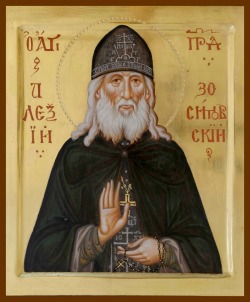
Great Schema Hieromonk
The life of the Venerable Alexius of Zosimov is not marked by a particular dynamism of external events. The Lord concealed him from prisons, exiles, and camps, but the number of internal sorrows he endured would be enough for more than one life.
He was a representative of the honor and conscience of the Orthodox Church in the conditions of Bolshevik terror, treating the Living Church movement and liberal clergy harshly, while remaining a loving elder to all suffering faithful children of the Mother Church.
His father came from a poor family, but through hard work and humility, he received an excellent education and became a professor of history and German language. His mother was pious and kind, dying when her son was eight years old.
The future ascetic was born in 1846 and from childhood showed a serious character. He loved to read and to be alone, growing up as a calm and kind boy.
His sorrows began at a young age: at eight, he was struck by the tongue of a bell in the temple and lost his right eye. At 17, he had his first heart attack, which did not leave him until the end of his life.
Despite his illnesses, he received a good secular and spiritual education, loved music, and played the piano. In 1866, he graduated from the seminary and married Anna Smirnova, who was kind and cheerful. The marriage was short-lived: Anna died of rapid tuberculosis, leaving Fyodor with a young son.
After his wife's death, Fyodor found it difficult to combine his duties in the church with raising his son. The care of the child was taken over by the servant Matryona, but she had a tendency to alcoholism, which created difficulties.
The spiritual perfection of Fyodor was influenced by the priests of the church where he served. He was characterized by humility, simplicity, and love for people, giving to the poor everything he had.
He served as a deacon for 25 years, and in 1895 he was ordained as a priest and appointed to the staff of the Great Assumption Cathedral in the Kremlin. His appointment was related to his remarkable vocal abilities.
In 1898, he took monastic vows under the name Alexius and began serving at Zosimov Monastery, where he faced harsh treatment from the igumen.
In this environment, the spirit of the great elder was formed. His humility and patience were astonishing. He showed kindness and mercy even to those who wronged him.
Over time, people began to come to him for advice and prayerful help, including pilgrims, monks, and high-ranking officials. His fame as a prayerful intercessor and miracle worker spread throughout the country.
He recommended his spiritual children to read the New Testament and practice the Jesus Prayer. In 1917, he participated in the election of the Patriarch of the Russian Orthodox Church, drawing lots with the name of Saint Tikhon.
In 1919, he was tonsured into the schema, and in 1923, Zosimov Monastery was closed. The last years of his life were difficult; he suffered from illnesses and need, but continued to pray for people.
He died in 1928. At his funeral, a multitude of people gathered, and even among them were opponents of the faith, but the believers responded to the insults with the singing of the Trisagion.
In 1994, the relics of the elder were transferred to the newly opened cathedral of the Smolensk-Zosimov Monastery, and in 2000, he was canonized as a saint.
