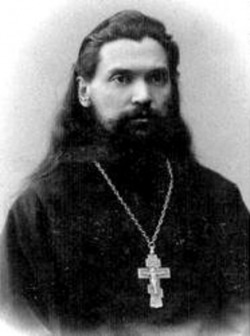
Presbyter
He was born in the Kolomensky district of the Moscow province, in the village of Kurkino. His father was a priest; before the revolution, he had a horse, a cow, and 10 beehives. He graduated from the theological seminary and was ordained a priest in 1901. He served in the church of the Yakotsky pogost until August 1909, after which he became the rector of the church in honor of St. Seraphim of Sarov in the village of Novo-Kuntsevo near Moscow. The church was consecrated on August 9, 1909, and he became its first rector. In 1913, he also taught the Law of God at the Kuntsevo commercial school.
After the change of government in 1917, the church went through difficult times. In May 1922, all silver utensils were confiscated 'for the benefit of the starving.' At the end of that year, the monastery was abolished, and the church became a parish church. Alexander Rusinov continued his ministry until 1926. From 1926 to 1929, nothing is known about him. In 1930, he was convicted by the OGPU Collegium for anti-Soviet activities and for concealing church valuables; he was in a concentration camp in the city of Kotlas until 1933.
From 1934, he was the rector of the church of Cosmas and Damian in Bolshево. On January 17, 1938, he was arrested by the Mytishchi department of the NKVD. The basis for his arrest was an accusation of counter-revolutionary agitation. On January 24, 1938, the case was transferred to the NKVD Troika for consideration, and on January 26, he was sentenced to the highest measure of punishment. On January 31, 1938, he was shot at the Butovo firing range along with 312 other people. He was rehabilitated on December 12, 1958. On April 11, 2006, the Archdiocesan Council of the Russian Orthodox Church canonized him; his day of remembrance is considered to be January 31.
