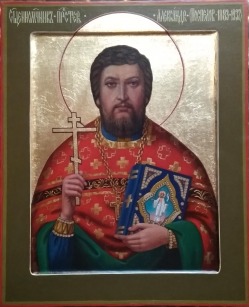
Presbyter
Saint Alexander was born on March 21, 1883, in the city of Vladimir. The family lived in hardship, and after the death of his father in 1898, relatives took care of the orphans. Alexander graduated from the Vladimir Theological Seminary and became a teacher. He married Lydia Konstantinovna, and they had six children. In 1904, Alexander was ordained as a deacon and then as a priest. He served in the village of Vaganovo, and later in the church in the village of Teterino, where he encountered persecution. In March 1929, he was invited to serve in the village of Kiberghino, where he became a preacher and a responsive pastor for the parishioners. His sermons were powerful and ignited faith, which led to discontent among the local communists.
On May 21, 1929, in Kiberghino, the bells were removed, which caused outrage among the peasants. Father Alexander preached about the persecution of the Church, which led to his arrest on June 25, 1929. He was imprisoned in Shuya, where the investigation took place. On November 3, 1929, he was sentenced to three years of imprisonment in a concentration camp and was sent to Solovki.
After his arrest, his family suffered from poverty. His daughter, while studying in school, received news of his life in 1935. Father Alexander was elevated to the rank of protodeacon and appointed as a priest in the village of Bolshoye Pesochnoye. In 1937, he was arrested again and sentenced for 'counter-revolutionary activity.' On December 14, 1937, the NKVD troika sentenced him to execution, and he was shot on December 26, buried in an unmarked grave at the Bugrovsky cemetery in Nizhny Novgorod.
