Schemamonk
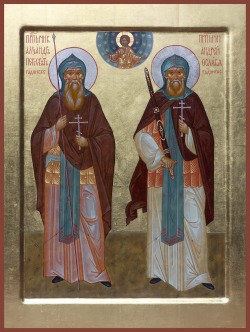
Saint Alexander (Peresvet) of Radonezh was a boyar from the region of Bryansk. An experienced warrior, he dedicated himself to God and embraced monastic life. On 18 August 1380, Prince Dmitry of Moscow sought the blessing of Venerable Sergius of Radonezh before the Battle of Kulikovo. He also requested the support of two warrior-monks, Alexander-Peresvet and Andrei-Oslyabya. Venerable Sergius sent them as “incorruptible weapons” and representatives of the Cross of the Lord, instructing them to fight for the Christian faith.
On the way to the battlefield, Alexander stopped at the hut of a hermit, to whom he entrusted his staff. On the Feast of the Nativity of the Most Holy Theotokos, before the Battle of Kulikovo began, he accepted the challenge of an enemy warrior to engage in single combat. Both men lost their lives, an event that was regarded as a spiritual sign for the Russian forces and for their forthcoming victory.
The body of Venerable Alexander-Peresvet was buried near the Church of the Nativity of Theotokos. His heroic deed became widely known among the people, while his name was recorded among those who fell on the field of Kulikovo. In the seventeenth century, he was glorified as a saint.
A memorial was later erected at the site where the relics of the two monks, Alexander and Andrei, had been buried. In the nineteenth century, the saint’s staff was transferred to a museum. In 1928, the church was closed and the memorials were destroyed. However, they were restored in 1989. In 2006, the staff was returned from the Ryazan Museum to the church.
In 1981, the names of the holy warrior-monks were included in the Synaxis of the Saints of Radonezh. Their memory is commemorated on 7 September, the eve of the Feast of the Nativity of the Most Holy Theotokos.
