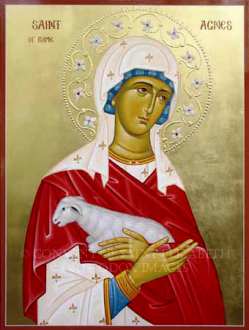
Saint Agnia was born in ancient Rome and was raised in the Christian faith. At the age of thirteen, she was betrothed to Christ, rejecting earthly suitors. A young man, the son of the provincial governor Symphronius, fell in love with her and tried to win her over, but Agnia refused, declaring her devotion to Christ.
When the governor learned of her faith, he sought to force her into marriage with his son, but Agnia steadfastly refused, even under threats. She rejected idolatry and was unafraid of suffering, asserting that her virginity belonged to Christ. In response to her courage, the governor ordered her to be brought to trial.
Agnia was stripped and brought to the house of harlots, but God protected her, and her nakedness was covered by her long hair. She prayed, and her virginity was guarded by an Angel. One of the young men who attempted to assault her was killed by a demon for his audacity. After this, Agnia resurrected him through her prayer, which led to the conversion of many pagans to Christianity.
In response to the miracle, the pagan priests were outraged and demanded Agnia's execution. She was thrown into the fire, but the flames did not harm her. Ultimately, she was killed by the sword, and she accepted martyrdom, being bathed in her own blood.
The parents of the saints, grieving for their daughter, saw her in a vision where she comforted them. Later, the holy martyr healed the daughter of Emperor Constantine, which led to the construction of a church in her honor. A monastery for maidens was established at her burial site, where many received healing and grace.
